Unknown's avatar

About Rawish Kumar Prajapati

Microsoft Dynamics CRM Consultant MCSE : Microsoft Business Application

RIP SDK – Dynamics CRM 365 v9

As per the recent communication from Microsoft, Microsoft Dynamics CRM SDK will not be available on Microsoft downloads. If you are working on Dynamics 365 v9, well you have to download every component which was available in the SDK individually.

Every tool will be available via NuGet Manager.

The name will be : Developer Guide not Dynamics CRM SDK.

For more information, visit the below blog :  https://blogs.msdn.microsoft.com/crm/2017/11/01/whats-new-for-customer-engagement-developer-documentation-in-version-9-0

Here is the step by step information on how to download these tools using powershell :  https://docs.microsoft.com/en-us/dynamics365/customer-engagement/developer/download-tools-nuget


i hope this helps.

Cheers!


How to set PartyList in Microsoft Dynamics CRM using Javascript

Let make it a smallest blog possible.

below code i have been using without any issue when it comes to setting a partylist or multi lookup in CRM. In the below code i am retrieving the contact id or the id of entity which is there in the regarding field & setting it on the “From” field.

function setCallFrom() 
{
 var lookup = new Array();
 lookup = Xrm.Page.getAttribute("regardingobjectid").getValue();
 if (lookup != null) {
 var name = lookup[0].name;
 var id = lookup[0].id;
 var entityType = lookup[0].entityType;
 if (entityType == "contact") {

var value = new Array();
 value[0] = new Object();
 value[0].id = id;
 value[0].name = name;
 value[0].entityType = "contact";

Xrm.Page.getAttribute("from").setValue(value);
 }

}
}

With slight modifications you can use the code on any other activity if you need to set partylist.

Call this function on Onload of the record or on onchange of the regarding field.

hope this helps!

Cheers!

Color Subgrid in Microsoft Dynamics CRM 365

Microsoft dynamics CRM is definitely turning colorful and interesting(has been always to me but in terms of look and feel). Recently subgrid’s in CRM have taken a full swing be in terms of editing them or looking colorful.

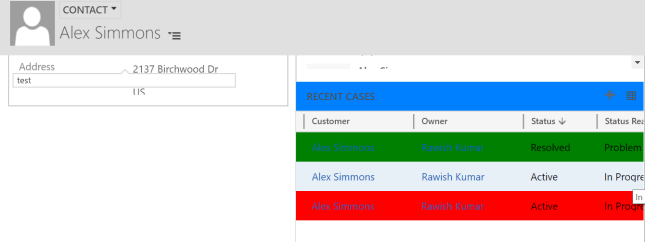
I tried something with my dynamics crm 365 trial and this is how it looks :

color

Now if i talk about above picture – it is actually a combination of Out of the box feature and UNSUPPORTED feature.

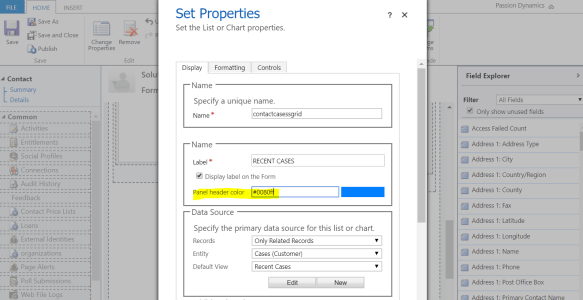
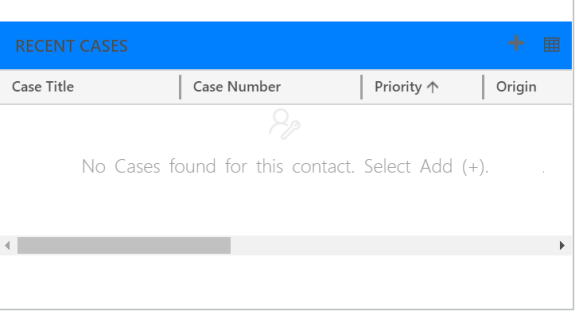
  1. The header of the subgrid can be configured to use any color by clicking on subgrid properties from form editor like below:color2.PNGto make the most of out of this color option you need to know the exact hexa/html code of the color, i used this website to get the code : http://htmlcolorcodes.com/colo3
  2. For the second feature i have actually used unsupported javascript below :
    function subGridOnload()
    {
    var grid = $('#contactcasessgrid'); //Replace Grid name here
    if (grid == null)
    {                            // delay one second and try again.
    setTimeout(subGridOnload, 1000);
    return;
    }
    if(grid[0] == undefined)
    {
    // delay one second and try again.
    setTimeout(subGridOnload, 1000);
    return;
    }
    if(grid[0].control == undefined)
    {
    // delay one second and try again.
    setTimeout(subGridOnload, 1000);
    return;
    }
    if(grid[0].control == null)
    {
    // delay one second and try again.
    setTimeout(subGridOnload, 1000);
    return;
    }
    if (grid[0].control.get_totalRecordCount() == -1)
    {
    // delay one second and try again.
    setTimeout(subGridOnload, 1000);
    return;
    }
    
    // logic Replace status names and colours as required
    
    $('#contactcasessgrid td').filter(function() {
    return $(this).text() == 'Resolved';
    }).closest('tr').css('background-color', 'Green');
    $('#contactcasessgrid td').filter(function() {
    return $(this).text() == 'Active';
    }).closest('tr').css('background-color', 'Red');
    }


    As seen in the above code , i am assigning Green color to Resolved cases and Red color to Active cases on the subgrid.

    you can read any value in the subgrid and apply any color to it.

    hope this helps.

    cheers!

Show entity form based on a field value in Microsoft Dynamics CRM

Having multiple forms for an entity is definitely amazing since you can control visibility of fields without having to write business rule or Javascript to hide hundreds of fields based on some value.

Now out of the box you can control CRM forms visibility/preference using security roles. However it is not you would always want to to do; sometimes you might have to control form preferences based on field value.

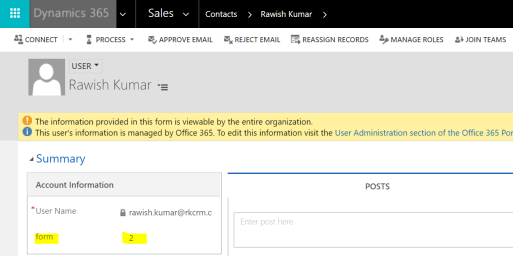
here is the sample code that i am using – on load of create/update/all forms i am retrieving a value from owner of that record – since on creation only owner gets filled up.  I have create a field “new_form” as a whole number on system user :

1

i have currently have it a value as “2”. lets see how i am going to retrieve this value in my code and set the correct form :

//do a webapi action to retrieve the form value from systemuser.

var formnewvalue = ' ';
function retrieveFromValue() {
 debugger;
 var userid = Xrm.Page.getAttribute("ownerid").getValue();
 var newid = userid[0].id.slice(1, -1);
 var req = new XMLHttpRequest();
 req.open("GET", Xrm.Page.context.getClientUrl() + "/api/data/v8.2/systemusers(" + newid + ")?$select=new_form", true);
 req.setRequestHeader("OData-MaxVersion", "4.0");
 req.setRequestHeader("OData-Version", "4.0");
 req.setRequestHeader("Accept", "application/json");
 req.setRequestHeader("Content-Type", "application/json; charset=utf-8");
 req.setRequestHeader("Prefer", "odata.include-annotations=\"*\"");
 req.onreadystatechange = function () {
 if (this.readyState === 4) {
 req.onreadystatechange = null;
 if (this.status === 200) {
 var result = JSON.parse(this.response);
 var new_form = result["new_form"];
 var new_form_formatted = result["new_form@OData.Community.Display.V1.FormattedValue"];
formnewvalue = new_form_formatted;

 showForm();

 } else {
 Xrm.Utility.alertDialog(this.statusText);
}
 }
 };
 req.send();
}
function showForm() {
 debugger;
var lblForm;
var relType = formnewvalue

switch (relType) {
case "1":
lblForm = "Portal Contact";
break;

case "2":
lblForm = "Profile Web Form";
break;

default:
lblForm = "Contact";

}
 //check if the current form is form need to be displayed based on the value
 if (Xrm.Page.ui.formSelector.getCurrentItem().getLabel() != lblForm) {
 var items = Xrm.Page.ui.formSelector.items.get();
 for (var i in items) {
 var item = items[i];
 var itemId = item.getId();
 var itemLabel = item.getLabel()
 if (itemLabel == lblForm) {
 //navigate to the form
 item.navigate();
 } 
 } 
 }
}

if you notice my switch statement you will see i m assigning the name of the forms to the values that i will be setting on the user profile.

Once it gets the form name – it than runs through all the forms for this entity untill it fins the correct form and then navigates to it.

i would say this script is majorly needed for first time or for a new system – since Internet Explorer or Chrome keep the form preference , so once our code the job and opened the required form -next time even if we remove the script -it will opening that form.

Another good is – this script prevents user to switch to other form as whenever  a user try to switch the form – on load event triggers and again check the value from owner id and change it back to the required one.

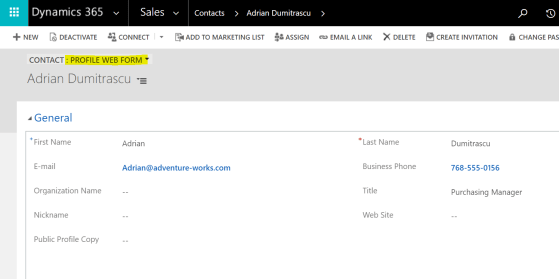
so since i have assigned value “2” to my user i should see “Profile Web Form” , lets see if this works :

2.jpg

woo , it did work.

point to note is you will have to attach this script to all the forms in the entity and call the function on onload for all forms.

hope this helps!

cheers!

Calculation Using Business Rules in Microsoft Dynamics CRM

Hi Guys,

We all love business rules & i am a big fan of them since they save alot of your time developing javascript for small actions that you need perform for e.g from making a field mandatory to setting fields value or showing error message.

Well , fortunately business rules can help if you need to perform some simple calculation on a form based on field values too. Lets get into action.

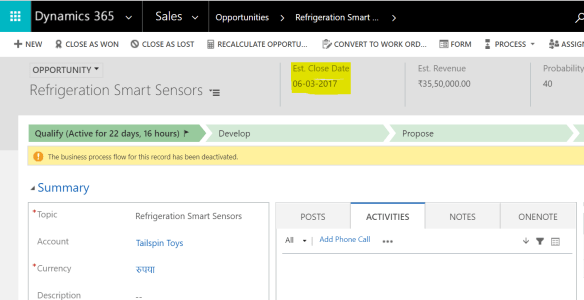
I have thought of a silly scenario where if i have estimated closed date on opportunity – i would like to set a date of 10 days before the estimated closed on a custom date field that i have created. Based on that i can then perform some other action using this new value either with JavaScript or business itself. This is dynamics crm 365 trial that i am using but its pretty much similar in 2016 or 2015.

So lets create a business role.

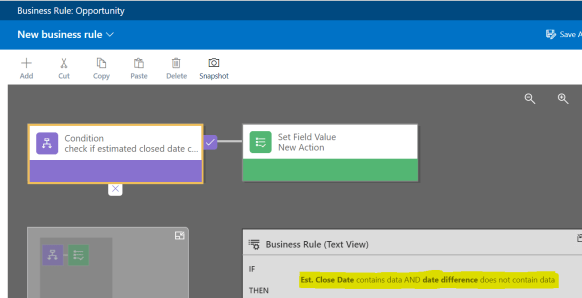
  1. Add a new condition to check if Est. Closed date contains data AND the new field(date difference) doesn’t not contains data.
    please note that if we don’t check the second condition the business rule will run every time and set the value to date difference on every on load even if date difference has been set last time :1
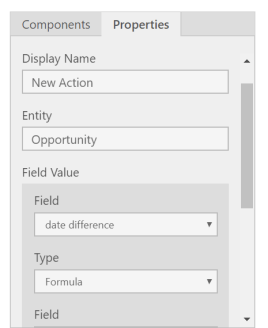
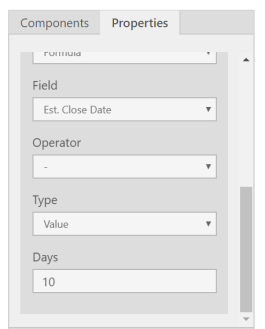
  2. Now once we are done with condition , lets add the action to it “set field value”. and from right side select the field = “date difference” , Type = “Formula”, other field = “Est Closed Date” , Operator = “-“, Type = “Value” , Days = “10”. Take a look at reference below:
    2
    3
  3.  now lets apply , save , Activate the business rule.
  4. Lets open a record a with estimated closed date and see it in action 🙂
    4
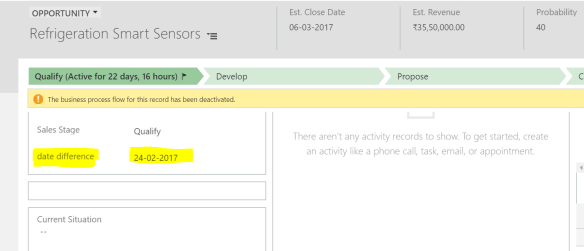
  5. the date difference field has been set to 10 days before the est close date which is 24-02-2017.
    5.PNG

There you go , it was simple example but i am sure you can perform some more complex calculation and not on just date fields but on currency and other fields.

Hope this helps!

Cheers!

Learn Microsoft Dynamics CRM – Basics, Customization & Configuration

aads-education-offers-microsoft-dynamics-crm-training-2-638

In office, while i am blogging or in dynamics community ; i always get this question that how a fresher can start learning CRM. Well let me tell you learning CRM is very easy since it is a Microsoft technology in which we have been living & using from our outlook to windows.

Well on internet ; information is pretty much distributed and in bits & pieces but i have collected the below information in sequence on how you  can you start from zero and go till 100 🙂

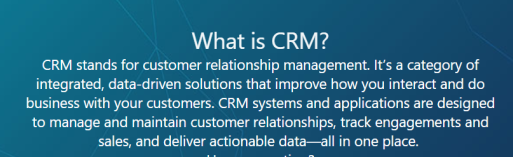
  1. First things first you should know what is CRM , well according to microsoft definition is :
             crm definition.PNG

    “CRM solutions streamline processes and increase profitability in your sales, marketing, and service divisions. A strong CRM solution is a multifaceted platform where everything crucial to developing, improving, and retaining your customer relationships is stored. Without the support of an integrated CRM solution, you may miss growth opportunities and lose revenue because you’re not maximizing your business relationships.”

  2. Next i would suggest you to see above everything in action :  https://www.chalkstreet.com/microsoft-dynamics-crm-tutorial    ,  https://mva.microsoft.com/en-us/training-courses/introduction-to-microsoft-dynamics-365-17593?l=J6OdOYtqD_906312570
  3. Once you have done this – i think you will be pretty much comfortable having your own CRM environment to get your hands dirty in, therefore go ahead and get your trial :https://trials.dynamics.com/
  4. Time to know how CRM can be available to you(to be technical “deployment options available in CRM”) :  https://www.powerobjects.com/2015/10/21/upgrading-crm-crm-online-vs-on-premises-finding-the-best-fit-for-your-organization/
  5. Once you understood all above, my suggestion for you is to now understand the core concepts which makes the whole CRM :

https://www.tutorialspoint.com/microsoft_crm/microsoft_crm_overview.htm

In this tutorial you will learn about what are the core components of  CRM like Entities , Fields, Forms, Business process flows etc. This blog also pretty much explains how you can customize the crm.

6. Now go though this blog and do same in your trial version :

https://crmbook.powerobjects.com/system-administration/customization/

i will talk about customizing, fields, forms , entities , charts, dashboards,solutions etc.

7. Security model – Now this is a major topic which you must understand very well without which it will be very difficult for you to master dynamics crm else you will be missing out on very small/minor things during your career

https://www.youtube.com/watch?v=_vfp3C11a3Mhttps://www.youtube.com/watch?v=An-VgsHEp9A

8. Now , one of the main features of crm is “Processes” , processes are the main component in CRM which helps you to perform actions based on your needs :

a. business rules :  http://www.inogic.com/blog/2016/12/business-rules-dynamics-365/

b. Workflows :  https://crmbook.powerobjects.com/system-administration/processes/workflows/

c.Plugins :  https://crmbook.powerobjects.com/extending-crm/plug-in-development-and-workflow-extensions/plug-ins/developing-a-plug-in/

9.Apart from it most of the stuff you would do through JavaScript which you coudnt  using business rule, mainly javascript is used to perform complex logics else i always recommend you to use business rules  :  https://www.youtube.com/watch?v=wxMB-cIQPUw


if you go through all of the above carefully , you will be in a position to work on dynamics crm confidently.

Please leave your comment if i have missed out anything major or you have any question, need guidance on any of the topics above.

happy crm learning, cheers!

Lock all fields on a form using Javascript- Microsoft Dynamics CRM

Hi Guys,

We all get requirements to lock the whole form to stop people from editing the record.

There are some out of the box options available to achieve this :

  1. Create a business rule : you can easily create a business and use lock field feature however you will have to select all the field on the form one by one – for .e.g if you have 50 fields on the form, you will have to add action for all of them. Moreover another limitation is if a field is removed from the form – you business rule will stop working.
  2. We all know if record is status is set to inactive – form become uneditable but in this scenarios we want to keep the record but uneditable.

Therefore, we come down to our final easy solution to tackle all problems above, the Javascript. Have a look on the below code :

 function disableFormFields()

{

       Xrm.Page.ui.controls.forEach(function (control, index) {

           var controlType = control.getControlType();

           if (controlType != “iframe” && controlType != “webresource” && controlType != “subgrid”)

           {

               control.setDisabled(true);

           }

       });

}

above code takes the control of the form directly rather then of each field & locks all of them. Just call the function on Onload , I have used this on my form and it looks like below:

lockfield


Now you can definitely add your own logic into this code for .e.g you put a if condition to check some value based on which you want to lock all fields and another things if you need to leave some fields unlocked you can again you a if condition , check the value and use below

just add the below code to above code :

if (crmfield = abc)

{

Xrm.Page.ui.controls.get(“CrmFieldShcemaname1”).setDisabled(false);

Xrm.Page.ui.controls.get(“CrmFieldShcemaNam2”).setDisabled(false);

Xrm.Page.ui.controls.get(“CrmFieldShcemaNam2”).setDisabled(false);

}


hope this helps you!

cheers

How to insert dynamic values from custom entities in an email template – Microsoft Dynamics CRM

if you work with email templates; you might have to create a template which is to be sent from a custom entity & hence you will need field values from that entity.

Now out of the box – CRM doesn’t provide you an option to populate the field values from a custom entity.

So lets dig in and understand ; how this can be done.

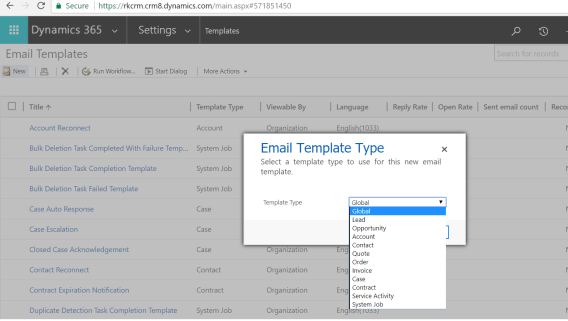
1.Go to Templates from CRM settings and click on email templates ; click on “new” & in the popup select template as “Global”:
1

now if you notice – CRM gives you templates for individual entities as well but since we need one for custom entity – we will have to select global.

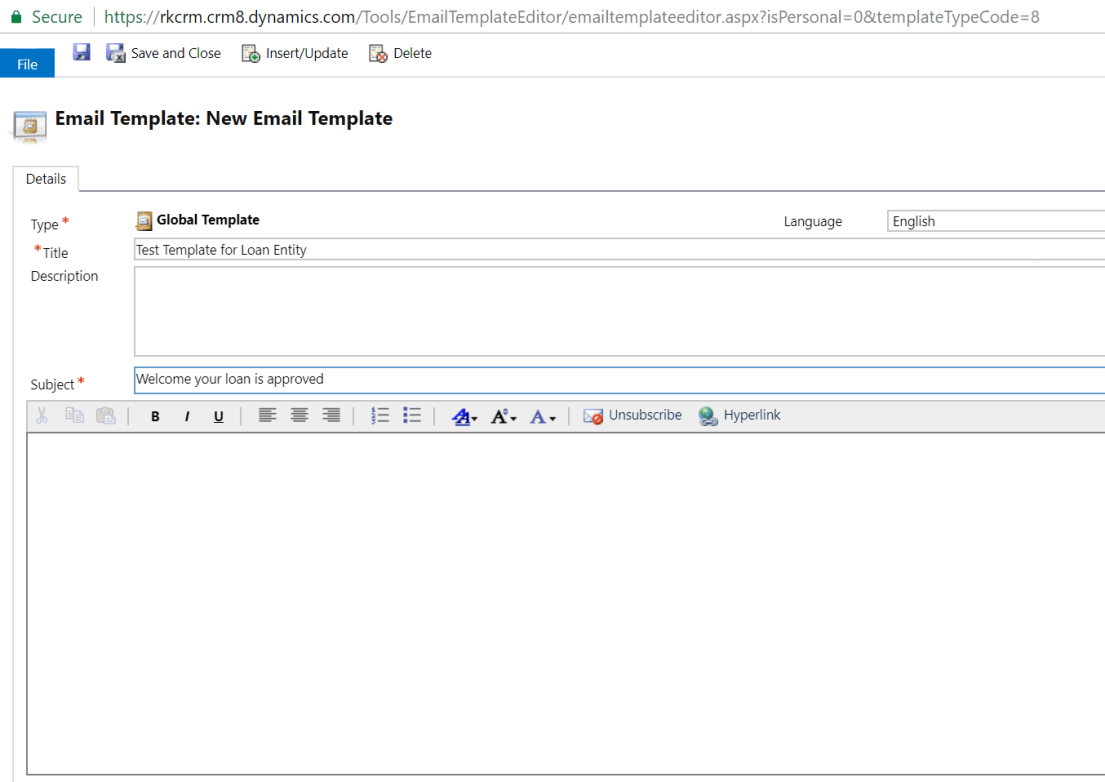
2. In the Template form, fill subject & Title.
2

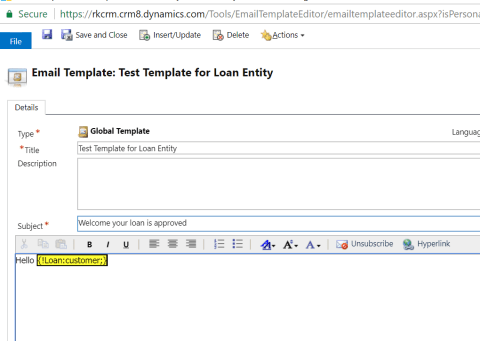
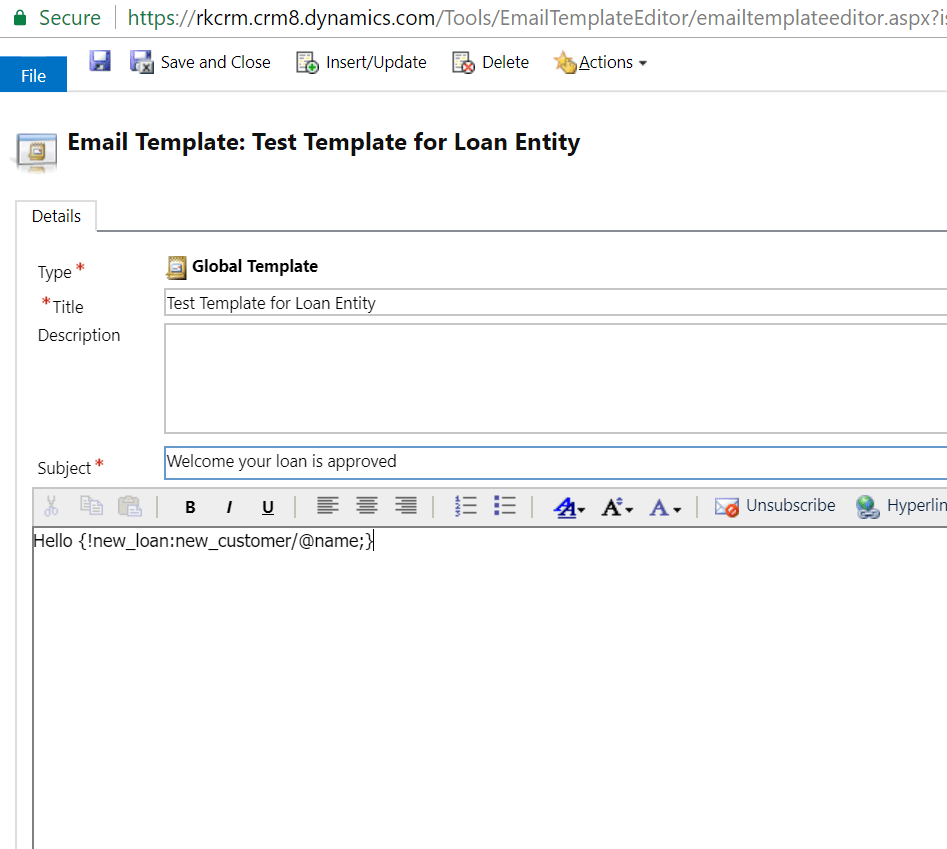
3.In this example – i have a custom entity Loan, i would like to send email from this entity using an email template with Loan amount and customer populated. Customer is a lookup so lets do it.

Standard format is : {!EntityLogicalName:FieldLogicalName;}

for lookup values ; you would want to retrieve the name so you have to do it like below :
3

4. Hit save and it will be resolved:

4.png

5. now lets retrieve the loan amount which is a currency field:
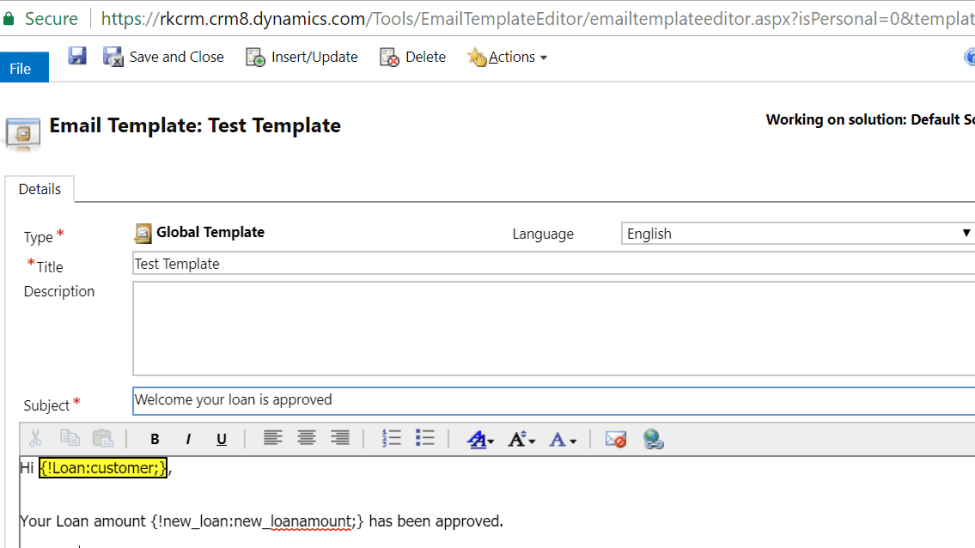
5

6. Hit save and see the how this resolves as well:
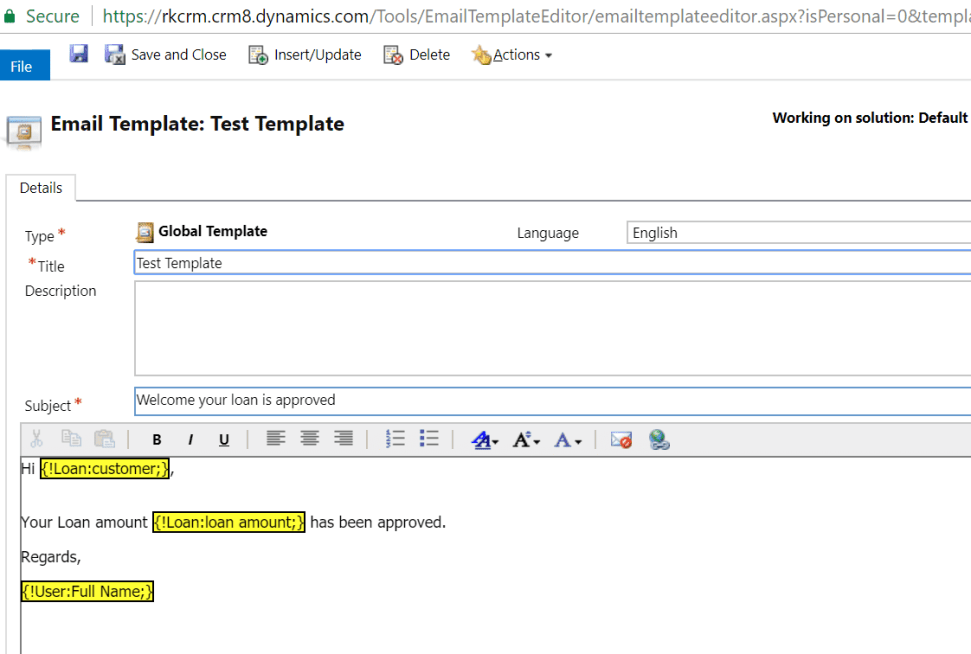
6

if you have noticed – i have also inserted the current user name from out of the box feature “insert/update” from top button.

Similarly, you can do this with other fields like below :

single line of text : {!EntityLogicalName: FieldLogicalName; Default Text}

Date :  {!new_loan:new_approvaldate/@date;}
Time : {!new_loan:new_approvaldate/@time;}

Lookup : as we did above

Optionset : {!new_loan:new_loantype/@name;}

7. Now lets see our template in action ; i will go the loan entity record and insert a template:
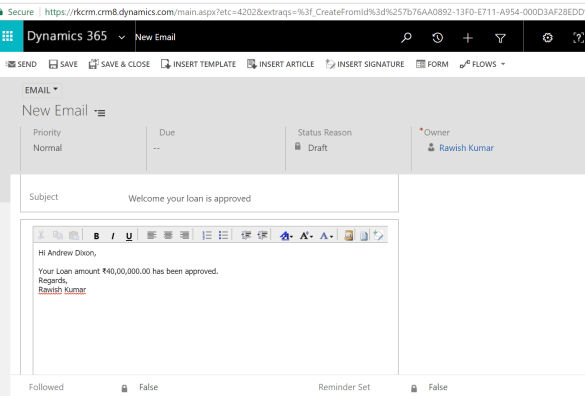
7

Yay! it worked like a charm.

so , that is how it is done. Let me know if you face any difficulties.

Cheers!!


Sample code to retrieve more than 5000 records using FetchXML in CRM

Fetch XML – fetch 5000+ record in plugin – blog by Nishant

Nishant Rana's avatarNishant Rana's Weblog

Hi,

Sharing a sample code to retrieve more than 5000 records using the Fetch XML.

Version 1 :

Version 2 :

Hope it helps..

View original post